
How Much Does It Really Cost to Charter a Private Jet in 2026? (Full Breakdown by Aircraft)
You get a five-figure quote for a two-hour flight. Where does the money go, which aircraft fits your trip, and which line items are actually negotiable in 2026?

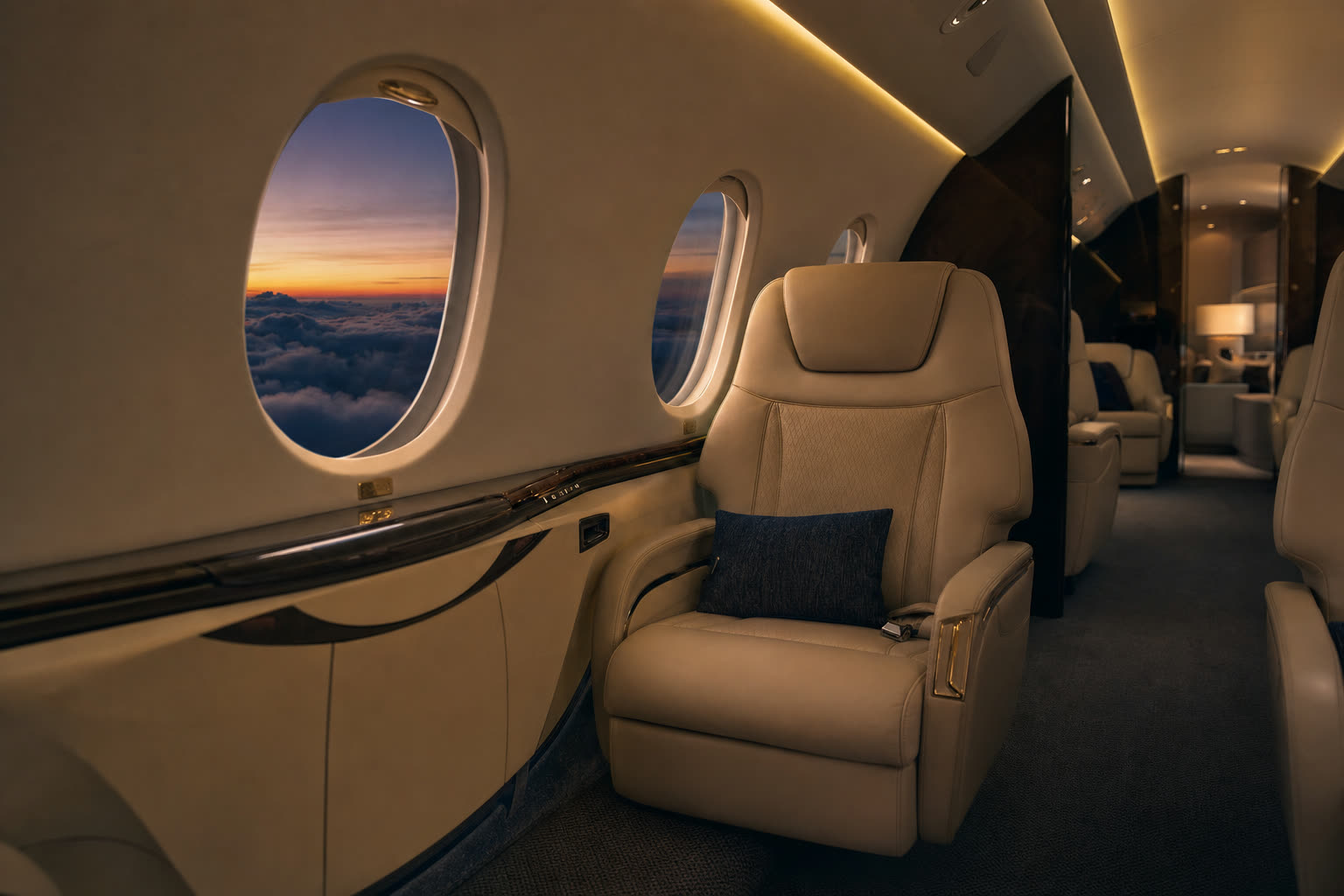
Charter quotes look opaque because they usually arrive as a single all-in number: 65,400 EUR, taxes included. The reality is that every quote is built from six distinct cost buckets, and the number that lands in your inbox depends heavily on which aircraft category the desk quoted, the season, and where the jet happens to be sitting the night before your flight. This 2026 update adds a hourly-rate table by category, three sample all-in trips, and the market context that has moved prices this year.
2026 quick reference: hourly rate by aircraft class
These are the ranges we see across the marketplace in mid-2026 for a well-maintained aircraft with a reputable operator (ARGUS Gold or better). Rates are per block hour and exclude landing fees, taxes and positioning.
| Category | Typical aircraft | Range (nm) | Pax | 2026 hourly rate (USD) |
|---|---|---|---|---|
| Turboprop | Pilatus PC-12, King Air 350 | 1,500–1,800 | 6–8 | $2,500 – $3,800 |
| Very light jet | Citation Mustang, Phenom 100 | 1,100–1,300 | 4–5 | $3,400 – $4,600 |
| Light jet | Citation CJ3+, Phenom 300, Learjet 75 | 1,600–2,100 | 6–8 | $4,200 – $6,200 |
| Midsize | Hawker 900XP, Citation Latitude | 2,600–2,900 | 7–9 | $6,000 – $8,200 |
| Super-midsize | Challenger 350, Praetor 600, Citation Longitude | 3,200–4,000 | 8–10 | $7,500 – $10,500 |
| Heavy | Falcon 900LX, Challenger 650, Legacy 650 | 3,800–4,700 | 10–14 | $9,000 – $12,500 |
| Ultra-long-range | Gulfstream G650ER, Global 7500, Falcon 8X | 6,700–7,700 | 13–19 | $13,500 – $22,000 |
Two important caveats. First, these are hourly rates — the total invoice equals hourly rate multiplied by block time, plus everything else in this post. Second, the same tail number can be quoted at very different rates depending on positioning: an aircraft five miles from your departure airport will price at the low end; the same aircraft ferrying in from another country prices at the high end.
Three real 2026 sample trips
London → Nice, one way, 4 passengers
A 2h flight on a light or midsize jet. Positioning is usually short (Farnborough or Luton to Nice is well trafficked). Expect:
- Phenom 300 (light jet): €13,500 – €17,000 all-in
- Citation Latitude (midsize): €18,500 – €22,500 all-in
- Same route as an empty leg during Cannes / Monaco season: €6,000 – €9,000 if you can flex your date by 24 hours
New York (Teterboro) → Los Angeles, one way, 6 passengers
Transcontinental. Needs a super-midsize (with a tech stop) or heavy jet non-stop, roughly 5h30 westbound.
- Challenger 350 (super-midsize) non-stop: $52,000 – $62,000 all-in
- Gulfstream G450 (heavy) non-stop: $68,000 – $82,000 all-in
- Global 7500 (ultra-long-range, empty return positioning): $95,000 – $120,000 if the aircraft has to return
London → Dubai, one way, 8 passengers
Ultra-long-range territory, 6h30 non-stop with a full cabin. Heavy jets can do it with a tech stop in Athens or Larnaca.
- Falcon 900LX (heavy) with tech stop: £85,000 – £105,000 all-in
- Global 7500 (ultra-long-range) non-stop: £130,000 – £165,000 all-in
The heavy-with-tech-stop option saves you 20–30% but costs 90 minutes on the ground in the Mediterranean. Time-cost tradeoff to make consciously.
The six buckets inside every quote
Every all-in number, however it is packaged, breaks down into these six line items. Ask your broker for the itemised version if you don't see them.
1. Flight time on the aircraft
The base cost is the aircraft's hourly rate multiplied by the total block time, which includes ferry legs and any positioning between the operator's base and your departure airport. On a two-hour passenger leg from London to Nice, you may be paying for four hours of aircraft time if the jet started the day in Munich. Ferry cost is the biggest hidden driver on short-notice charters and the one worth pushing back on: ask what the aircraft's next confirmed flight is and whether the ferry can be shared.
2. Landing, handling and parking fees
Airports charge private movements per landing and per hour of parking. Amounts vary wildly. London City is more than £3,000 for a midsize jet landing plus handling; a regional French airport can be under €400. Long parking (over 24 hours) adds meaningful cost. A quote should itemise these; if it doesn't, ask.
3. Fuel and 2026 fuel surcharges
Fuel is billed on the hourly rate, but a fuel surcharge appears when jet-A1 spikes above the operator's base assumption. Through 2025 and into 2026, most operators reset their base assumption twice; expect a surcharge line of 3–8% on European charters and 4–10% on North American charters during peak season. Sustainable aviation fuel (SAF) is now offered as a paid add-on by most reputable operators — typically a 15–25% premium on the fuel line for a 30% SAF blend. It shows up as a separate opt-in item on the quote.
4. Crew and cabin crew
Two pilots are mandatory. A cabin attendant is standard on super-midsize jets and above, optional on midsize, and rare on light jets. Overnight allowances (per diems) kick in when the crew stays away from base; on multi-day trips these can add several thousand euros. On heavy and ultra-long-range aircraft flying more than 8 hours, some operators now require an augmented crew (3 pilots), which adds a per-day rate.
5. Taxes
Domestic legs inside the EU carry VAT on passenger transport in most jurisdictions (rates 5–19% depending on member state). UK domestic legs carry APD. US domestic legs carry the 7.5 percent federal excise tax and per-segment charges. International legs are usually tax-free but not always. Any confusion here is a reason to ask for a written breakdown.
6. Broker margin
Independent brokers earn 5 to 15 percent of the total. Operators quoting direct do not pay this margin but often do not shop competing operators for you either, so quote comparison is on you. This is the line item where a good broker earns its keep: shopping ten operators, catching hidden positioning, and forcing standardised terms.
What changed in 2026
Three shifts have moved the market this year and it's worth understanding them because they explain why quotes feel higher than 2023 memory.
- Fleet age. A wave of pre-owned aircraft transactions in 2022–2024 pulled several thousand jets into fresh 5-year maintenance cycles, and operators are recovering those costs through higher hourly rates. Rates on well-maintained midsize jets are up roughly 8–12% since 2023.
- Global 7500 and G700 delivery ramp. The ultra-long-range category is finally seeing new aircraft on the marketplace. Rates at the top of the market have stayed firm because demand exceeded supply for two years; only in H2 2026 are we seeing meaningful softening for spot G650ER availability.
- SAF mandate anticipation. EU ReFuelEU Aviation regulation requires 2% SAF blend from 2025 rising to 6% by 2030. Operators are pre-buying SAF at premium prices and passing the cost through. Expect this line item to grow.
Where the negotiation lever actually sits
You cannot negotiate fuel, taxes or landing fees; they are pass-through. You can influence positioning cost (by shifting departure day, departure time, or accepting an alternative airport 40 km away), and you can influence broker margin (by getting two or three parallel quotes). You can also often step down one aircraft category if your passenger count and baggage really fit — a Phenom 300 on London–Nice with four adults saves €5,000–8,000 over a Latitude and gets you there in the same 2 hours. Everything else is essentially fixed for the flight profile you asked for.
How to use this in practice
Before you accept a quote, ask three questions. First: what is the aircraft's positioning — where is it starting the day, and how much of my invoice is ferry? Second: which line items are pass-through and which are the operator's margin? Third: is there an empty leg on my route in a ±48 hour window? A good desk answers all three without hesitation. If yours doesn't, get a second quote.